World War II Infantryman, kneeling in front of M3 Half-track, holds and sights an M1 Garand rifle. Fort Knox, Kentucky, June 1942.
The Carrier, Personnel Half-track M3 was an armored vehicle used by the United States, the British Empire and the allies during World War II and the Cold War.
 M3 Halftrack armored cars Fort Knox. Three halftrac armored cars move in formation as soldiers in training at Fort Knox, Kentucky practice some new methods in the art of mechanized warfare. Capable of rapid travel over difficult terrain, these versatile cars have many important uses in an army on the move.History
Between the world wars, the US Army sought to improve the tactical mobility of its forces. With the goal of finding a high-mobility infantry vehicle, the Ordnance Department had evaluated the half-track design by testing French Citroën-Kégresse vehicles. The White Motor Company produced a prototype half track using their own chassis and the body of the M3 Scout Car.
 M-3 Halftrack Ambulance near Anzio, Italy.
The design, using as many commercial components as possible to improve reliability and speed production, was standardized in 1940 and built by the Autocar Company, Diamond T Motor Company, and the White Company.
 Anti-aircraft halftracks to support initial wave of the assault against Hitler’s Europe begins are being loaded onto an LCT in a British port, 1944.
Offered with a choice of White 160AX or IHC RED 450 engines, the M3 was driven through a manual constant-mesh (non-synchromesh) transmission with four forward and one reverse gear, as well as a two-speed transfer case. Front suspension was leaf spring, tracks by vertical volute spring. Braking was vacuum-assisted hydraulic, steering manual, without power assist. The electrical system was 12-volt.

The M3 was the larger counterpart to the M2 Half Track Car. The M2 was originally intended to function as an artillery tractor. The M3 had a longer body than the M2 with a single access door in the rear and seating for a 13-man rifle squad. Ten seats were arranged down either side of the vehicle, with three in the cab.

Racks under the seats were used for ammunition and rations; additional racks behind the seat backs held the squad's rifles and other stowage. A small rack for mines was added on the outside of the hull just above the tracks. In combat, most units found it necessary to stow additional food, rucksacks and other crew stowage on the outside of the vehicle. Luggage racks were often added in the field, and very late vehicles had rear-mounted racks for this crew stowage.

Early vehicles had a pintle mount just behind the front seats mounting a .50 caliber (12.7 mm) M2 Browning machine gun. The later M3A1 adopted a raised, armored 'pulpit mount' for the .50 caliber, and .30 caliber (7.62 mm) machine guns could be used from mounts along the sides of the passenger compartment. Many M3s were later modified to the M3A1 standard. The body was armored all around with an adjustable armored shutter for the engine's radiator and a bullet proof windscreen.

Total production of the M3 ran to nearly 41,000 vehicles. To supply the Allied nations International Harvester produced several thousand of a very similar vehicle, the M5 half track for Lend-Lease.
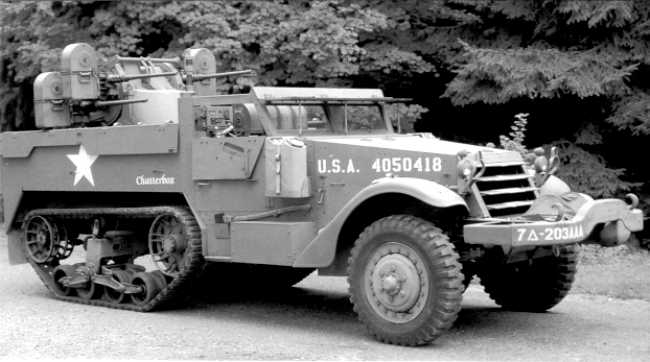
 Crew firing Quad Mount Cal. 50 M17 Multiple Gun Motor Carriage, 21 AAA, Korea, 1953.VariantsArmored personnel carriers
 M3 halftrack on display in Ursel, Belgium.M3
- White Half-Track with White 386 cu in (6,330 cc) 160AX engine. Fitted with either an M32 anti-aircraft machine gun mount or a pedestal mount, both featuring an M2HB machine gun.
 M3A1 personnel carrier on display in Belgium.M3A1
- Any vehicle with the improved M49 machine gun ring mount over the right hand front seat. Between 1942 and 1943 all M3 Half-Tracks (standard and A1s) were continually upgraded. These improvements included a number of drive train, engine, and stowage improvements.
 T29/M3A2
- Developed in 1943 to combine features such that existing M2 and M3 production could be switched to a common vehicle. Came at a time where the need for additional half tracks turned out to be not as great as projected. The M3A2 was, therefore, not produced.
M3E2/M5 - International Harvester Half-Track, externally virtually identical to the M3, but with 450 cu in (7,400 cc) IHC RED-450-B engine, different drive train and fuel and electrical system. In fact, only the chassis, bogies, track, idler and drive sprockets, wheels, winches, transfer case, rollers, and machinegun mount were interchangeable. The M5 is heavier than the M3, due in part to heavier armor. Its rear body sides were in one piece, rather than bolted. The M5 was primarily for Lend-Lease, to Britain, Canada, France, and the Soviet Union.
 M5A1
- As for the M3A1, an M5 with the M49 machine gun mount. It could fit one .50 (12.7 mm) and two .30 (7.62 mm) MG.[20] The IHC models had a slightly lower top speed (only 42 mph (68 km/h)) and lower range (125 mi (201 km)) as well.
 T31/M5A2
- Similar in principle to the M3A2, a vehicle developed by the US Ordnance Department to combine the production of the M5 and M9 into a single vehicle. As with the M3A2, the projected need was never seen, and this version was never produced en masse.
M9 - Same as the M5, with stowage arranged as in the M2 halftrack, with access to radios from inside (as opposed to outside) and rear doors, plus pedestal MG mount.
M9A1 - Same as M9, with ring mount and three MG pintles.
Self-propelled gunsT12/M3 75 mm GMC - M3 based Gun Motor Carriage equipped with the M1897A5 75 mm gun. These guns were fitted with the gun's M2A3 ground carriage and its gun shield. Later variants featured a purpose-built gun shield (59 rounds).
M3A1 75 mm GMC - The M2A2 gun carriage was substituted for the A3, as stocks were exhausted. Later variants featured a purpose-built gun shield.
T12 HMC - M3 based Howitzer Motor Carriage equipped with the 75 or 105 mm Pack Howitzer by the US Marine Corps.
 An American T48 57 mm GMC based on a M3 Halftrack called SU-57 by the Soviet and Polish armies in front of the Polish Army Museum.T48 57 mm GMC
- M3 based Gun Motor Carriage equipped with the M1 57 mm gun, an American copy of the British QF 6 pounder anti-tank gun. A total of 962 T48s were produced during the war. Of these, 60 were supplied under lend lease to Britain, and 650 to the USSR - who called it SU-57 (99 rounds).
 T30 75 mm HMC
- M3 based Howitzer Motor Carriage equipped with the M1A1 75 mm howitzer in a simple box mount (60 rounds). Used by the US Army. Also provided to the Free French Army, later used in Indochina.
T38 105 mm HMC - M3 based Howitzer Motor Carriage equipped with the M3 105 mm howitzer. Cancelled with the success of the T19.
 T19 105 mm HMC
- M3 based Howitzer Motor Carriage equipped with the M2A1 105 mm howitzer (8 rounds).
 T19/M21 81 mm MMC
- M3 based Motor Mortar Carriage equipped with the M1 mortar (81 mm)(97 rounds), designed to allow the mortar to be fired from within the vehicle.
T21 - M3 based mortar carrier fitted with a 4.2 inch mortar. Never adopted.
 T21E1
- The T21's mortar could only fire rearward as with the M2 based M4 MMC. The T21E1 reoriented to the mortar to fire forward.
Anti-aircraft variantsT1E4/M13 MGMC - M3 based Multiple Gun Motor Carriage equipped with the Maxson M33 mount with 2 M2HB machine guns (5,000 rounds). The T1E4 prototypes had the hull sides removed for easy of working with the mount. These were reintroduced on production M13s. This was a development of previous T1s that had all been based on the M2 Half-track Car.
 M14 MGMC
- M13 MGMC variant, based on the M5 chassis. Supplied under lend-lease to Britain (5,000 rounds).
 M16 MGMC
- M3 based Multiple Gun Motor Carriage equipped with the Maxson M45 Quadmount (more specifically the M45D) with 4 M2HB machine guns (5,000 rounds).
M16A1 MGMC - Standard M3 Personnel Carriers converted to Multiple Gun Motor Carriages by removing rear seats and installing a Maxson M45 mount (more specifically the M45F, which featured folding "bat wing" gun shields on both sides of the mount over the machine guns). These vehicles are easily identified by the lack of the folding armored hull panels found on purpose-built M16s.
M16A2 MGMC - M16 MGMC variant, basically M16s brought up to M16A1 standard and with the addition of a rear door to the hull compartment. For existing M16s, this essentially meant a replacement of the M45D mount for the M45F mount.
 M17 MGMC
- M16 MGMC variant, based on the M5 chassis built by International Harvester. Most were sent under lend-lease to the USSR (5,000 rounds).
 T58
- Similar to the M16/M17, the T58 featured the Maxon quad-mount fitted to a special electric powered turret. Prototype only.
T28E1 CGMC - M3 based Combination Gun Motor Carriage equipped with one M1A2 37 mm autocannon (240 rounds) flanked by 2 M2WC machine guns (3,400 rounds). The original T28 had been based on the shorter M2 Half-Track Car chassis.
M15 CGMC - T28E1 variant, equipped with an armored superstructure on the turreted mount to provide crew protection, and switched to M2HB machine guns.
 M15A1 CGMC
- Reorganization of the weapons, with the M2HB machine guns being fitted under the M1A2 37 mm autocannon instead of above as on the M15.
T10E1 - Variant to test the feasibility of mounting US made copies of the Hispano-Suiza HS.404 20 mm cannon on modified Maxson mounts. All were later rebuilt as M16s. The original T10 was based on the shorter M2 Half-Track Car chassis.
40 mm Experiments - Various attempts were made to mate the 40 mm Bofors L/50 gun to the M3 chassis. In all cases the weapon's recoil was too severe or the mounting too heavy, and the attempts were finally stopped with the adoption of the M19 MGMC on the M24 light tank chassis.
 T54/E1
- Tested in 1942, the gun mount quickly proved to be unstable when fired, and the improved T54E1, which also added a circular armored shield and rear armor to the vehicle, could not fix the inherent problem. Prototype only.
 T59
- A development of the T54/E1, fitted with outriggers to help stabilize the vehicle during sustained firing. Still proved to be too unstable for anti-aircraft use. Prototype only.
 T59E1
- T59 fitted with the T17 fire control system. Prototype only.
 T60/E1
- Similar to the T54 and the T59, but featured two .50 caliber M2 machine guns flanking the 40 mm cannon (the mounting's designation was T65).

The T60E1 featured an armor configuration similar to that of the T54E1. Suffered from the same stability issues of previous attempts. Prototype only.
 T68
- Perhaps the most radical of the experiments, the T68 featured two 40 mm cannons one mounted on top of the other plus a stabilizer on top of the two guns. The recoil force proved to be too much for the mount, and the idea was abandoned. Prototype only.
M15 "Special" - Field conversions by US Army depots in Australia of standard M3s, not M15s, fitted with turreted 40 mm Bofors L/50 guns. These were the only successful mating of this weapon to the M3 chassis, and were used more for direct fire support than for anti-aircraft purposes.
 Modified Iraeli M3 halftrack armed with a 20 mm anti-aircraft cannon in Batey ha-Osef Museum, Tel Aviv, Israel.Post-war Israeli variantsM3 Mk. A
- M5 APC. Israeli Half-Tracks were all designated M3, even M2/M9 variants.
The Mk. A APCs are identified as IHC M5s by the use of RED-450 engines for the most part. While the M49 mount was retained, a variety of machine guns were used.
M3 Mk. B - M5 converted as a command carrier with extra radios and a front winch bumper. Mk. Bs featured M2HB machine guns.
M3 Mk. C - Essentially an M21 MMC, an M3 type (assumed from the common use of the White 160AX engine) Half-Track with an M1 81 mm Mortar.
M3 Mk. D - Another M3 based mortar carrier, fitted with the 120 mm Soltam mortar. Entered service in 1960.
 M3 TCM-20
- M3/M5 Half-Tracks fitted with the Israeli TCM-20 armament turret with two 20 mm Hispano-Suiza HS.404 cannon fitted to old Maxson turrets. The right hand vision port was often replaced with a ball mount for a machine gun.
 M3 half-track with .30 (7.62 mm) Browning M1919 machinegun.Carrier, Personnel Half-track M3
Type Half-track armored personnel carrier
Place of origin United States
 The M3 75mm GMC - an M1897 75mm gun mounted on an M3 halftrack (the M3A1 halftrack was also used, resulting in - you'll never guess - the M3A1 75mm GMC). This photo shows an M3 75mm Gun Motor Carriage, assigned to the Special Weapons Company of the 2nd Marine Division, Tinian, 30 July 1944.Specifications
Weight 9.3 t
Length 6.18 m
Width 2.22 m
Height 2.26 m, wheelbase 135.5 in (3,440 mm)
Crew 3 + 10 troops
Primary armament 1 x 0.5 in (12.7 mm) M2 machine gun
Secondary armament 2 x 0.3 in (7.62 mm) M1919A4 machine guns
Engine White 160AX, 386 cu in (6,330 cc), 6 cylinder, petrol, compression ratio 6.3:1, 147 hp (110 kW)
Power/weight 15.8 hp/tonne
Suspension half track, vertical volute springs; front tread 64.5 in (1,640 mm) to 66.5 in (1,690 mm)
Fuel capacity 60 US gal (230 l)
Operational range 175 mi (282 km)
Speed 45 mph (72 km/h)
 Halftrack photographed on Cromer beach in Norfolk, May 1993 - Renosteel Construction Ltd.


 Left: M5A1 Stuart light US tank. Right: 75mm M3 GMC Tank Destroyer. The M5A1 was basically a better armored version of the earlier M3 Stuart, with add'l armor added around the sides of the upper chassis and the turret and an upgraded, Cadillac-produced engine. Armament: M6 37mm main gun, (2) .30 cal. machinegun (coaxial with main gun and at co-driver's position), (1) .50 cal. machinegun (turrert, pintel-mounted). Used primarily for recon and scouting missions. The 75mm GMC M3 was the only anti-tank means the US had at the start of WWII, being pressed quickly into service. It first saw action in North Africa, where it had a limited effect against the German Pzkfw III and IV main battle tanks. A main drawback was the limited side traverse of its gun. Armament: M1897 75mm field gun mounted in M3 halftrack chassis. Eventually replaced by the M10, M18, & M36 Tank Destroyers.

 M-3 Tank Destroyer with the 75mm gun, and it's five man crew.

 This black and white picture is from a magazine of the era, showing the M-3 Gun Motor Carriage.
 M3 75mm Gun Motor Carriage, Special Weapons Company, 2nd Marine Division, Tinian, in action on the 30th of July 1944.
 Almost invisible in the thick jungle vegetation, an M3 GMC supports Marine operations on Hill 660, Cape Gloucester, New Britain, December 1943 - January 1944. The barrel of the 75mm gun points to the left, just left of center.
 M3 75mm Gun Motor Carriage halftracks, airbase security, North Africa during WW II.
 M3 75mm Gun Motor Carriage, seen in Italy, 1945. A second vehicle is visible to the right.
 75-mm GMC M3.
 Stylized 75-mm GMC M3 used as insignia for U.S. Tank Destroyer Force soldiers.