Thursday, April 29, 2010

M6 heavy tank

M6.

The Heavy Tank M6 was an American heavy tank designed during World War II. The tank was produced in small numbers and never saw combat.

M6A1. Note its angular welded hull, as opposed to rounded cast hulls of M6 and T1E1.

History and description

Because of limited budgets for tank development in the interwar years, at the outbreak of World War II the US Army possessed few tanks, though it had been keeping track of armor use in Europe and Asia. Successful employment of armored units in 1939 - 1940, mostly by the Germans, gave momentum to a number of US tank programs, including a heavy tank program. The United States possessed a massive industrial infrastructure and large numbers of engineers that would allow for mass production of tanks.

T1E1.

Following the Chief of Infantry recommendation from 20 May 1940, the US Army Ordnance Corps started to work on a 50-ton heavy tank. Initially a multi-turreted design was proposed, with two main turrets armed with low-velocity T6 75mm (2.95") guns, one secondary turret with a 37 mm gun, and a coaxial .30 caliber (7.62mm) machinegun, and another secondary turret with a 20 mm gun and a coaxial .30 caliber machine gun. Four .30 caliber machineguns were to be installed in ball mounts, two in the glacis plate and two in the rear corners of the hull. The project was approved on 11 June 1940 and the vehicle received the designation Heavy Tank T1. The design was somewhat similar in concept to multi-turreted breakthrough tanks developed in Europe in the 1920s and throughout the 1930s, such as the British Vickers A1E1 Independent or the Soviet T-35. Disadvantages of these "land dreadnoughts", namely their excessive size, difficulty in coordinating actions of the crew, and high production costs, led to abandonment of the concept in Europe.

T1E2 prototype.

By October, the US developers reached the same conclusion as their European counterparts. The armament was changed to a single vertically-stabilized 3 inch (76.2 mm) gun and a coaxial 37 mm gun in a single three-man turret with both manual and electric traverse. The turret had a commander's cupola identical to that of the M3 Medium Tank. Additional armament consisted of two .50 caliber machine guns in a bow mount (operated by the assistant driver), two .30 caliber MGs in the front plate (fired electrically by the driver), one .30 caliber in the commander's cupola and one .50 caliber in a rotor mount in the right rear of the turret roof (operated by the loader). The crew consisted of commander (turret left), gunner (turret right), loader (turret), driver (hull left front), assistant driver (hull right front) and ammunition passer (hull).

Front view of M6, with several early M3 light tanks in the background.

One of the main challenges was developing a powerpack for such a heavy vehicle. The Wright G-200 air-cooled radial gasoline engine was selected by a committee formed by the Society of Automotive Engineers, but no suitable transmission was available. The committee recommended developing a hydramatic transmission, while a possibility of using a torque converter or an electric transmission was also to be checked.

Side view.

In 1941 - 1942 three prototypes were built by the Baldwin Locomotive Works, one with electric transmission and two with torque converter transmission. Variants with hydramatic transmission were never completed. The prototypes also differed in hull assembly method - one had welded hull and two cast hull. On 26 May 1942 two variants with torque converter transmission were standardized as M6 and M6A1. Standardization of the electric transmission equipped T1E1 as M6A2 was never approved, but manufacturing of the vehicle was nevertheless recommended. It was proposed by the Ordnance Corps that 115 T1E1s would be built for the US Army and 115 M6s and M6A1s for US allies. The production started in December 1942. Some minor changes were introduced in the production vehicles: the cupola was replaced by a double-door hatch with a ring mount, the machine gun in a rotor mount and the left front machine gun were removed.

Delivery of the first heavy tanks. The new fifty-seven-ton tank, known as the M-1 leading a parade of tanks in its initial tryout demonstration. Background is the M-3 medium thirty-eight-ton tank. The other two are the M-3 light thirteen-and-a-half-ton tanks.

However by the time the M6 was ready for production, the Armored Corps had lost interest in the project. The advantages the M6 offered over medium tanks - its much thicker armor and slightly more powerful gun - were offset partly by the shortcomings of the design - such as very high silhouette, awkward internal layout and reliability problems - and partly by logistical concerns. By the end of 1942, the Armored Corps were sure that the new M4 Sherman gave adequate solution for the present and the near future, while being reliable, cheap and much easier to transport.

Delivery of the first heavy tanks. This is what happens when a truck gets in the path of Uncle Sam's new fifty-seven-ton giant tank. Running over this piece is as much trouble for the tank as running over a curb in an average automobile. The revolving turret on top of the tank contains a three-inch gun and a thirty-seven-millimeter antiaircraft.

Work on M6 didn't stop at once. The T1E1 prototype was tested with a T7 90 mm gun and was found to be a satisfactory gun platform, although poor turret layout was noted again. In August 1944 the Ordnance Corps recommended using the T1E1s produced to build 15 77-ton vehicles designated M6A2E1, with thicker (up to 7.5 inch vertical protection) glacis armor and a turret developed for the T29 Heavy Tank, armed with a T5E1 105 mm gun. The proposal was rejected by General Eisenhower. However, by late 1942 main development effort shifted to other projects, one of which eventually resulted in the M26 Pershing.


On 14 December 1944 the M6 was declared obsolete. Only forty units were produced and they never left US soil. Several toured the United States for propaganda purposes, where they gave performance displays (such as car crushing) at War Bond drives and the like. All were eventually scrapped except for a single T1E1 which is on display at the United States Army Ordnance Museum, Aberdeen, Maryland.


Some suspension parts were used in the heavy Excelsior A33 Tank prototypes.


Variants

T1 - Cast hull, hydramatic transmission. Never built.

T1E1.

T1E1 - Cast hull, electric transmission. Often unofficially referred to as M6A2. 20 units built.

T1E2.

T1E2 / M6 - Cast hull, torque converter transmission. 8 units built.

M6A1.

T1E3 / M6A1 - Welded hull, torque converter transmission. 12 units built.

T1E4 - Welded hull, hydramatic transmission. Never built.

M6A2.

M6A2E1 - Uparmored T1E1 with a new turret armed with a T5E1 105 mm gun. Never built.

M6.

M6 heavy tank

Type heavy tank
Place of origin United States
Service history
In service trials only
Used by United States Army


Specifications

Weight 126,500 pounds (57.4 tonnes) combat loaded
Length 27 ft 8 in (8.43 m) gun forward
24 ft 9 in (7.54 m) gun aft
Width 10 ft 3 in (3.12 m) over track armor
Height 7 ft 10 in (2.38 m) to turret roof
10 ft 7 in (3.23 m) to top of .30 machinegun mount
Crew 6 (commander, gunner, driver, loader, assistant loader)
Armor Front 3.25 in (83 mm) at 30°
Upper sides 1.75 in (44 mm) at 20°
Lower sides 2.75 in (70 mm) at 0°
Turret front 3.25 in (83 mm) at 7°
Turret sides and rear 3.25 in (83 mm) at 0°
Primary armament 1 × 3in (76mm) gun M7 (75 rounds)
1 × 37mm (1.46 in) gun M6 (202 rounds)
Secondary armament 2 × Caliber .50 (12.7mm) Browning M2HB machineguns, hull (6,900 rounds)
2 × .30 Browning M1919A4 machine guns, one fixed (bow), one flexible AA (5,500 rounds)
Engine 1,823 ci (29.88 liter) Wright G-200 9-cylinder gasoline
825 hp at 2300 rpm
Power/weight 15.7 hp/tonne
Transmission Timken mechanical model 16001, three speeds (two forward, one reverse); rear drive sprocket
Suspension Horizontal volute spring
Ground clearance 20.5 in (52 cm)
Fuel capacity 477 US gallons (1,810 liters), 80 octane
Operational range 100 mi (160 km)
Speed 22 mph (35 km/h)

Tuesday, April 27, 2010

M8 Greyhound


The M8 Light Armored Car was a 6x6 armored car produced by the Ford Motor Company during the Second World War. It was used by the U.S. and British troops in Europe and the Far East until the end of the war.


The vehicle was widely exported and as of 2006 still remains in service in some third world countries. In British service the M8 was known as the Greyhound.


Development history


In July 1941, the Ordnance department initiated a development of a new fast tank destroyer to replace the M6 37 mm Gun Motor Carriage, which was essentially a 3/4 ton truck with a 37 mm gun installed in the rear bed.


The requirement was for a 6x4 wheeled vehicle armed with a 37 mm gun, a coaxial machine gun mounted in a turret, and a machine gun in the front hull.


Its glacis armor was supposed to withstand fire from a .50 cal. machine gun and side armor from a .30 cal. machine gun.


Prototypes were submitted by Studebaker (designated T21), Ford (T22) and Chrysler (T23), all of them similar in design and appearance. In April 1942 the T22 was selected despite complaints about deficiencies due to the need for vehicles.


By then it was clear that the 37 mm gun would not be effective against the front armour of German tanks so the new armored car, designated M8 Light Armored Car took on the reconnaissance role instead.


Contract issues and minor design improvements delayed serial production until March 1943. Production ended in June 1945. A total of 8,523 units were built, not including the M20 Armored Utility Car.


In 1942 the British turned down the opportunity to use the M8 through Lend-Lease. It was named Greyhound in keeping with other US armoured cars already ordered by the British such as the (cancelled) T18 Boarhound, the Deerhound and the Staghound.


The telescopic sight used to aim the main 37 mm gun.


Description


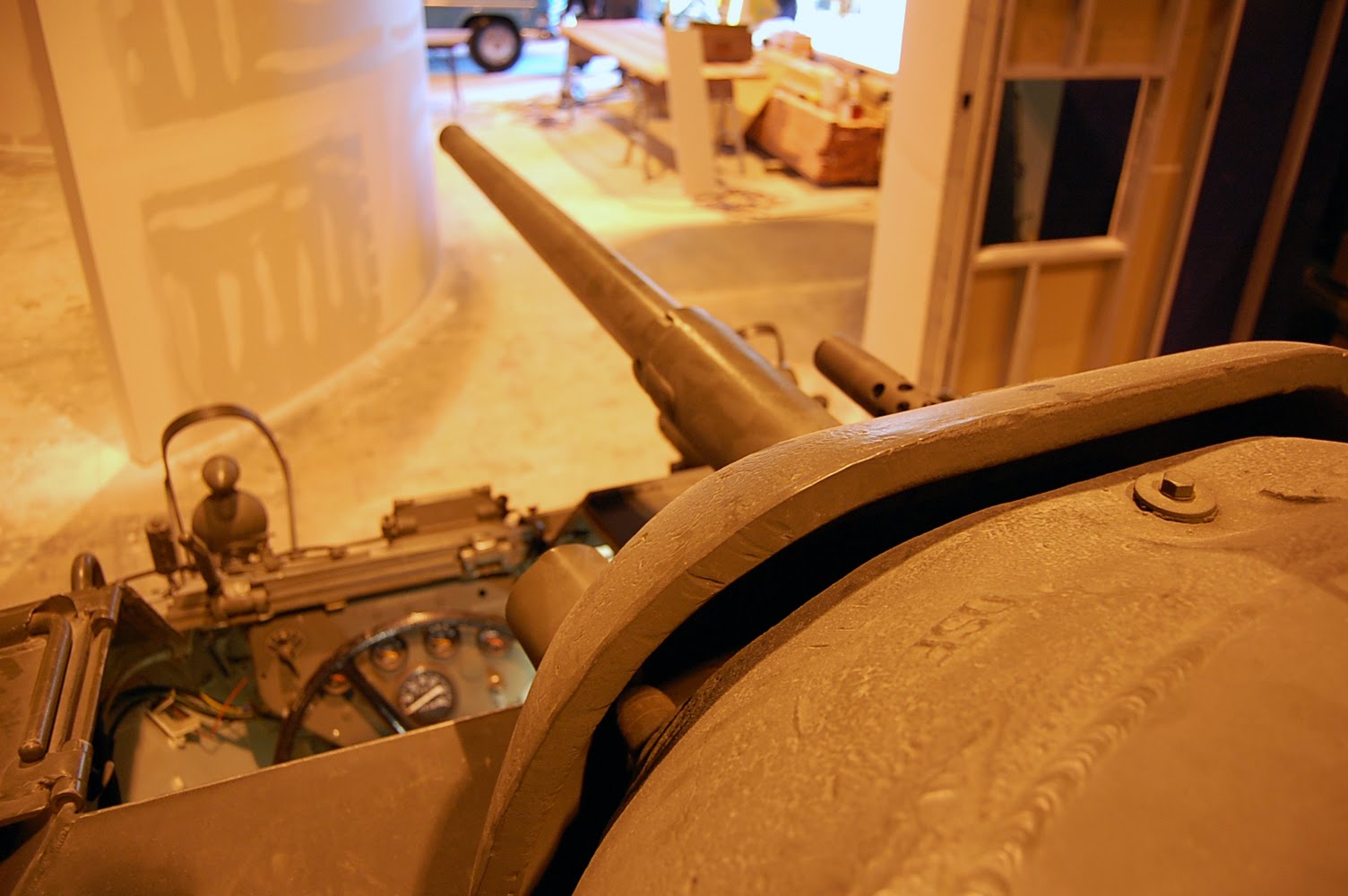
The M8 was fitted with a 37 mm M6 gun (aimed by M70D telescopic sight) and a coaxially mounted .30 Browning machine gun in an open-topped, welded turret.


An M2 Browning machine gun was sometimes carried on a ring or pintle mount for anti-aircraft use; this was not standard on early vehicles but was a frequent unit modification.


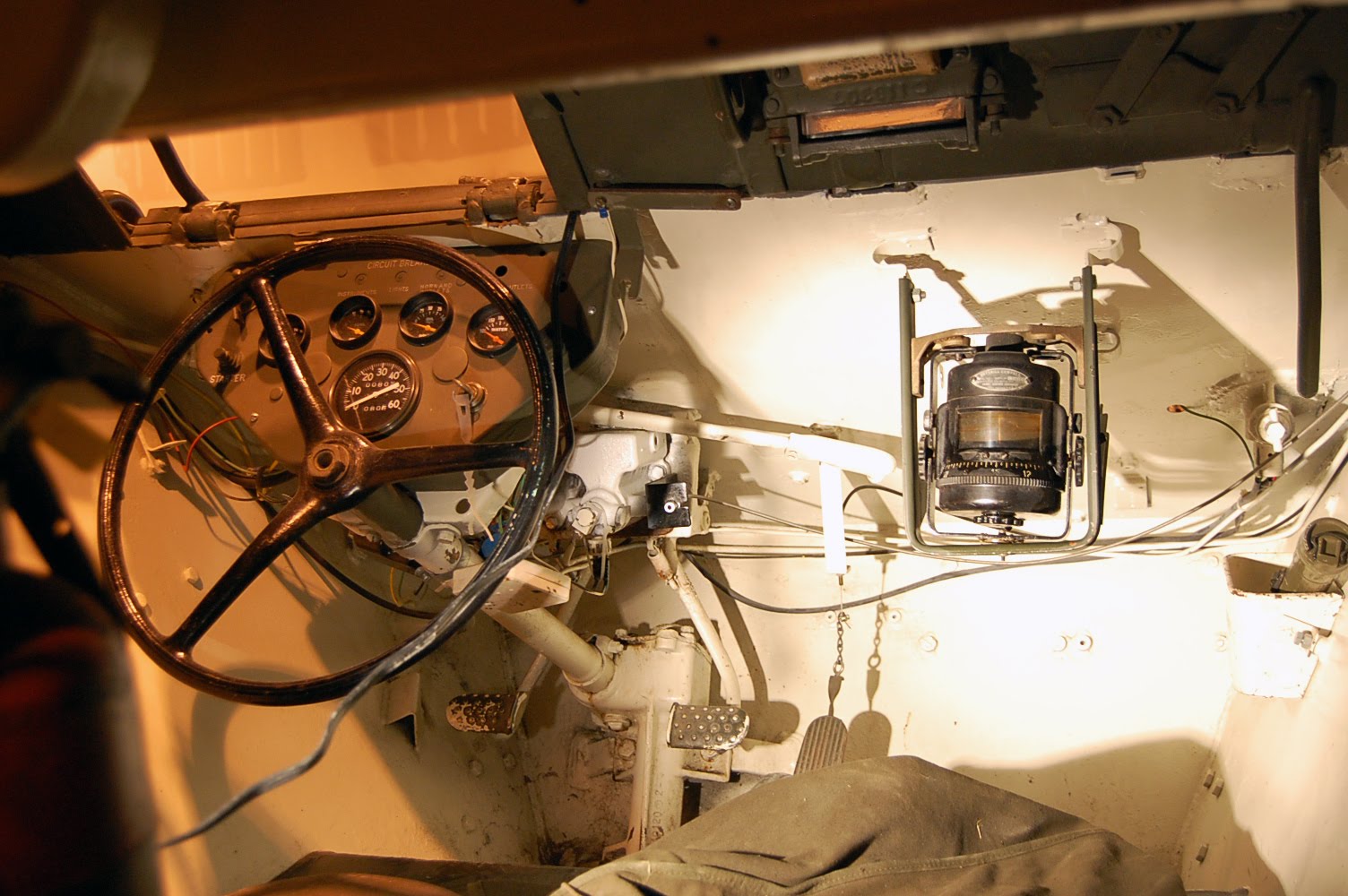
The crew of four comprised the commander (who doubled as loader), gunner, driver, and radio operator (who could also act as a driver). The driver and radio operator were seated in the forward section of the hull, while the commander and gunner rode in the turret, commander in the right side.


Shells for the main 37 mm gun are stored on racks inside the turret. The barrel of an M1 carbine, carried for personal defense, is visible at left.


The vehicle carried 80 37 mm rounds when fitted with a single radio. Vehicles with a second radio installed carried as few as 16 main gun rounds, although unit-level modifications could raise this as high as 40 or more.


Machinegun ammunition consisted of 1500 .30 cal rounds and 400 .50 cal rounds. In addition, it carried 16 hand grenades, 4 smoke pots (M1 or M2), 6 landmines (Anti-tank and HE types) and M1 Carbines for the crew.


The armor ranged from 3 mm on the hull floor, to 19 mm on the front hull and turret. The M8 was powered by a Hercules Model JXD in-line 6-cylinder 320 cu.in. gasoline engine giving it a top speed of 56 mph on-road, 30 mph off-road.


With a 59 gallon tank, and an average fuel consumption of 7.5 mpg it could manage an average range of 400 miles.


American troops in a M8 passing the Arc de Triomphe after the liberation of Paris.


Service history


The M8 first saw action in Italy in 1943 and was used by the US Army both in Europe and in the Far East.


In the latter theater it was occasionally employed in its original tank destroyer role as most of the Japanese armor was vulnerable to its 37 mm gun. Over 1,000 were supplied via lend-lease channels to Britain, France and Brazil.


The vehicle was considered fast, sufficiently reliable (after some technical problems were solved) and armed and armored well enough for reconnaissance missions. However, cavalry units criticized its off-road performance, which was even worse than the M3A1 Scout Car it replaced.


In the mountainous terrain of Italy and in the deep mud and snow of North European winter the M8 was more or less restricted to roads, which greatly reduced its value as a reconnaissance vehicle.


It was also very vulnerable to landmines. An add-on armor kit was designed to provide an extra quarter-inch of belly armor to reduce landmine vulnerability. Some crews placed sandbags on the floor to make up for the thin belly armor.


Another problem was that commanders often used their reconnaissance squadrons for fire support missions, for which the thinly-armored M8 was ill-suited. When it encountered German armored reconnaissance units, the M8 could easily penetrate their armor with its 37mm gun. Conversely, its own thin armor was vulnerable to the 20mm autocannons that German scout cars were equipped with.


The US Army Armour School's paper The Battle at St-Vith 17-23 December 1944 describes an engagement during the Battle of the Bulge, between an M8 (Troop B, 87th Cavalry Reconnaissance Squadron) and a Tiger tank. The M8 crew was the resounding victor, punching multiple 37mm rounds through the rear armour of the panzer.


M8 armored car with Constabulary markings.


The US Army started to look for a replacement for the M8 as early as 1943. Two prototypes, the Studebaker T27 and Chevrolet T28 were finished in summer 1944.


Both were found superior to the M8, but it was decided that at this stage of the war there was no more need for a new armored car.


After the war, the M8 was used for occupation duty, saw combat in the Korean War and was retired by the US Army shortly thereafter. France continued to use the M8 until the First Indochina War.


Many vehicles formerly used by the US, Britain and France were exported to NATO allies and third world countries. As of 2002, some still remain in service in Africa and South America.


List of operators


Past and present operators of the vehicle include:


Algeria

Austria

Belgium

Benin

Brazil

Britain

Burkina Faso

Cameroon

Colombia

Cyprus

El Salvador

Ethiopia

France

Germany - captured in World War II and saw service with the West German Border Guard after the war.

Greece

Guatemala

Haiti

Iran

Italy

Jamaica

Japan

Madagascar

Mexico

Morocco

Niger

Norway

Paraguay

Peru

Philippines

Portugal

Saudi Arabia

Senegal

South Korea

South Vietnam

Taiwan

Thailand

Togo

Tunisia

Turkey

USA

Venezuela

Yugoslavia

Zaire


Variants


T22.


T22 Light Armored Car - Prototype.


T22E1 Light Armored Car - A 4x4 prototype.


T22E2 Light Armored Car - Prototype eventually standardized as M8.


M8 Light Armored Car - Production variant.


M8E1 Light Armored Car - A variant with modified suspension. Two vehicles were produced in 1943.


M20 Armored Utility Car at the US Army Ordnance Museum.


The M20 Armored Utility Car, also known as the M20 Scout Car, was a Greyhound with the turret removed.


This was replaced with a low, armored open-topped superstructure and an AA ring mount for a .50 caliber M2 heavy machinegun AA. A bazooka was provided for the crew to compensate for its lack of anti-armor weaponry.


The M20 was primarily used as a command vehicle and for forward reconnaissance, but many vehicles also served as APCs and cargo carriers. It offered high speed and excellent mobility, along with a degree of protection against small arms fire and shrapnel.


When employed in the command and control role, the M20 was fitted with additional radio equipment. Originally designated the M10 Armored Utility Car, it was redesignated M20 to avoid confusion with the M10 Wolverine tank destroyer. 3,680 M20s were built by Ford during its two years in production (1943-1944).


T69 Multiple Gun Motor Carriage.


T69 Multiple Gun Motor Carriage - In late 1943 an anti-aircraft variant of the M8 was tested. The vehicle was armed with four .50 cal. machine guns in a turret developed by Maxson Corp.. The Antiaircraft Board felt that the vehicle was inferior to the M16 MGMC and the project was closed.


M8 TOW Tank Destroyer - M8 upgraded by the US company NAPCO. The main gun was replaced by an .50 cal machine gun and a BGM-71 TOW launcher was installed above the turret. Upgraded vehicles were used by Colombia.


M8/M20 with H-90 turret - A French upgrade, using the turret of the Panhard AML 90 armored car.


CRR Brasileiro - A version developed in 1968 by the Brazilian Army Engineering Institute (IME). The middle axle was removed and a new engine (120 hp Mercedes-Benz OM-321) installed to create the VBB-1 of which one prototype was completed, the vehicle being found to be inferior. The Vbb-1 was in turn the basis for the CRR which reverted to a 6x6 configuration and 8 vehicles were produced for evaluation. The EE-9 Cascavel was developed from the CRR.


M8 (Diesel) Hellenic Army Armored Car - A number of M8 Armored Cars were upgraded with a Steyr diesel engine in place of the Hercules JXD gasoline engine, this required a rearwards extension of the engine compartment by 30cm as well as some heightening. Also fitted were a new radio, indicator and new hooded lights, rear view mirrors, while the M2HB anti-aircraft machinegun was moved to the right front of the turret, where a new pintle socket was bolted on the partial roof (the turret rear socket being retained) and the coaxial 0,30" M1919A4 replaced by a 7,62x51mm NATO MG3 machinegun. Used for coastal defense and retired from service in the late 1990s.


M8 in the Media


An unarmed M8 is seen in use by the LAPD SWAT team in a failed assault on the fictional Nakotomi Plaza in the 1988 film Die Hard.

An M8 appears several times in the 1998 remake of the movie Godzilla.

The M8 is featured in the graphic novel "Alan's War: The Memories of G.I. Alan Cope" by Emmanuel Guibert (ISBN 978-1596430969). This collection of stories and anecdotes of the Alan Cope, a radioman assigned to an armored cavalry unit of Patton's 3rd Army, during the closing months of World War II. Details about the M8's operation and how it was perceived by its crewmen are discussed. Interestingly, it includes a story about the acquisition of a ring mount for the .50 caliber M2HB machine gun on top of the turret, which the crew apparently considered the only worthwhile weapon on the vehicle, as the 37mm anti-tank gun that armed the M8 was woefully underpowered even by the middle of the war.

A Greyhound is painted like a czech tank in the James Bond movie "The living daylights" (1987)

The M8 Greyhound is featured as the Americans' heavy reconnaissance vehicle in the real time strategy game Company of Heroes. It can be upgraded with an anti-infantry machine gun and better armour.


M8 equipped for battle.


M8 Armored Car


Type Armored car

Place of origin United States


Specifications


Weight 7.8 t

Length 5 m (16.4 ft)

Width 2.54 m (8.3 ft)

Height 2.25 m (7.4 ft)

Crew 4

Armor up to 19 mm (3/4 inch)

Primary armament 37 mm Gun M6

Secondary armament .30 and .50 MG

Engine Hercules JXD 6-cyl gasoline 110 hp (82 kW)

Power/weight 14.1 hp/tonne

Suspension 6x6 wheel, leaf spring

Operational range 563 km (350 miles)

Speed 90 km/h, 56 mph