


The M3 Scout Car was an armored car in U.S. service during World War II. It was also known as the White Scout Car, after its manufacturer, the White Motor Company. It was used in various roles including patrol, scouting, command vehicle, ambulance and gun tractor.

History
Design of the vehicle began at the White Motor Company, based in Cleveland, in 1937. It had .25 in (6.4 mm) face-hardened armor, full-time four-wheel drive (with no way to disengage it), four-speed manual constant-mesh (non-synchromesh) transmission (with one reverse gear) and two-speed transfer case, leaf spring suspension, manual steering, and (unusually for the period) vacuum-assisted (power) brakes. The wheelbase was 131 in (3.3 m), tread 65.25 in (1.657 m). The wheels were 8.5 in (220 mm) wide, 20 in (510 mm) diameter, and used standard 12-ply military non-directional tires. Fuel capacity was 30 US gal (110 l).

The original order was for 64 units, all of which were given to the 7th Cavalry Brigade. Eventually the Army decided to adopt an improved version, designated M3A1. The new version had a longer and wider hull. In front of the bumper an unditching roller was mounted. The M3A1 could carry up to seven infantry and provide fire support with three machine guns - one .50 caliber (12.7 mm) and two .30 caliber (7.62 mm) - mounted on a skate rail around the hull.

Production of the M3A1 started in 1940 and lasted until 1944, with 20,918 vehicles built.

The design influenced the later U.S. halftrack designs such as the M3 halftrack and the post-WW2 Soviet BTR-40. The early M2 halftrack copied the armor layout as well as the skate rail machine gun mounts.

Combat history
The M3A1 first saw combat in the Philippines in 1941-1942, and was also used by the cavalry units of the US Army in the North African Campaign and the invasion of Sicily. It was used in traditional cavalry roles such as scouting and screening; also as an armored command vehicle. By mid-1943, the drawbacks of the design - its open top, poor off-road mobility, and poor armament - were evident. During 1943 most US Army units replaced the M3A1 with the M8 armored car and similar M20 Utility Car. A small number of M3A1s were retained and employed in Normandy. A few M3A1s were used by the US Marine Corps in the Pacific theater, but none saw combat.

The M3A1 was also supplied via lend-lease channels to the Soviet Union (3034; remained in service at least until 1947) and Britain, and used to equip Free French Forces, Belgian, Czechoslovak and Polish units. After the war, many vehicles were sold, mostly to Asian and Latin American countries. In Red Army service it was used primarily as a reconnaissance vehicle, but also as gun tractor for the ZIS-3 76-mm field gun. It remained in wide service throughout the war. In British and French service M3A1s were used as observation vehicles for field artillery observers, as ambulances, and as scout vehicles.

A few vehicles were used by Israel in the 1948 Arab–Israeli War. At least one Israeli M3A1 was modified with top armor and a revolving turret. France employed its M3A1s in the First Indochina War and the Algerian War.

By late 1990, the only country to keep the M3A1 in service was the Dominican Republic.
 White scout car converted to ambulance.
Former operators
Belgium
Brazil
United Kingdom
Cambodia
Canada
Chile
Czechoslovakia
Dominican Republic
France
Greece
Israel
Lebanon - Regional Gendarmerie 1949-1959.
Laos
Philippines
Poland
Portugal
South Vietnam
USA
USSR
Norway
Yugoslavia

Variants
M3 (1938) - original variant. 64 units built.
M3A1 (1941) - bigger hull.
M3A1E1 - had Buda diesel engine. 100 units built.
M3A1E2 - had armored roof.
M3A1E3 - was fitted with 37 mm Gun M3 on mount T6 / M25. Never reached serial production.
M3A1 Command Car (1943) - thicker armor, armed with .50 cal MG.
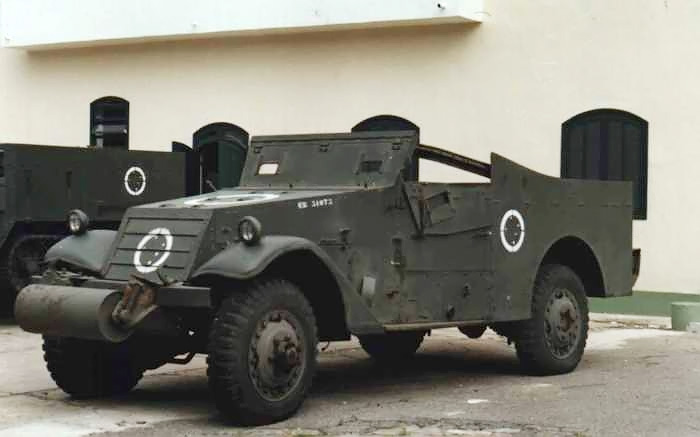 M3 Scout Car operated by the Brazilian Army.
M3A1 Scout Car
Type Armored car
Place of origin United States
Service history
Wars World War II, 1948 Arab–Israeli War, First Indochina War, Algerian War

Specifications
Weight 8,900 lb (4.0 t)
Length 222 in (5.6 m)
Width 80 in (2.0 m)
Height 79 in (2.0 m)
Crew driver + 7
Armor 6–13 mm
Primary armament .50 cal M2 Browning machine gun
Secondary armament .30 cal Browning M1919A4 machine gun
Engine Hercules JXD, 320 cu in (5,200 cc), L-head inline 6-cylinder, gasoline 110 hp (82 kW), compression ratio 6.5:1, Zenith Model 29 carburetor
Power/weight 19.4 hp/t
Suspension 4 x 4 wheel, leaf spring
Operational range 403 km
Speed 55 mph (89 km/h)


